

My second brain: how I use AI in business and personal life
I use several AI tools in parallel every day, but my entire system rests on one principle — files that I control. The story of how I wire AI into business and personal life, and why every person will need a system like this within the next 5 years.

Listen to this article
Narrated with an AI voice built from the author's voice.
I use several AI tools in parallel every day, switching freely between them. But my whole system rests on one principle — files that I control myself.
Why not one AI tool, but several
Many people I talk to about AI ask the same question. Which AI tool do you use? The answer is simple and, perhaps, unexpected. I use several in parallel and switch freely between them.
Each tool has its strengths. One is better at deep thinking and long context. Another is faster with short answers and real-time search. A third integrates better with specific platforms. I'm not looking for the one "best" tool. I pick the right tool for the task in front of me.
This approach asks one thing of you that many people don't consider. The context of your work must not be locked inside a single tool. If you keep all your work in one corporation's cloud, you become dependent on what that corporation decides tomorrow.
Your mind is for having ideas, not holding them. — David Allen, Getting Things Done
My answer to this problem is that context lives on my machine, not in someone else's cloud. AI tools only process the context I hand them.
My golden rule: MD and JSON files = the foundation
My whole system rests on one principle. Markdown and JSON files on my machine are the foundation, everything else is a layer on top.
Markdown is a simple text format that a human can read in any text editor. What you write today in Markdown will still work in 20 years. An open format can't be "taken off the market" by any corporation. JSON is a structured data format. I use it for client profiles, datasets and system settings.
My system is organised into 7 spheres. Body. Mind. Family. Network. Business. Money. Environment. Each sphere has its folder, each folder has its context. Above all of that sit 4 layers — present focus, long-term direction, projects, system.
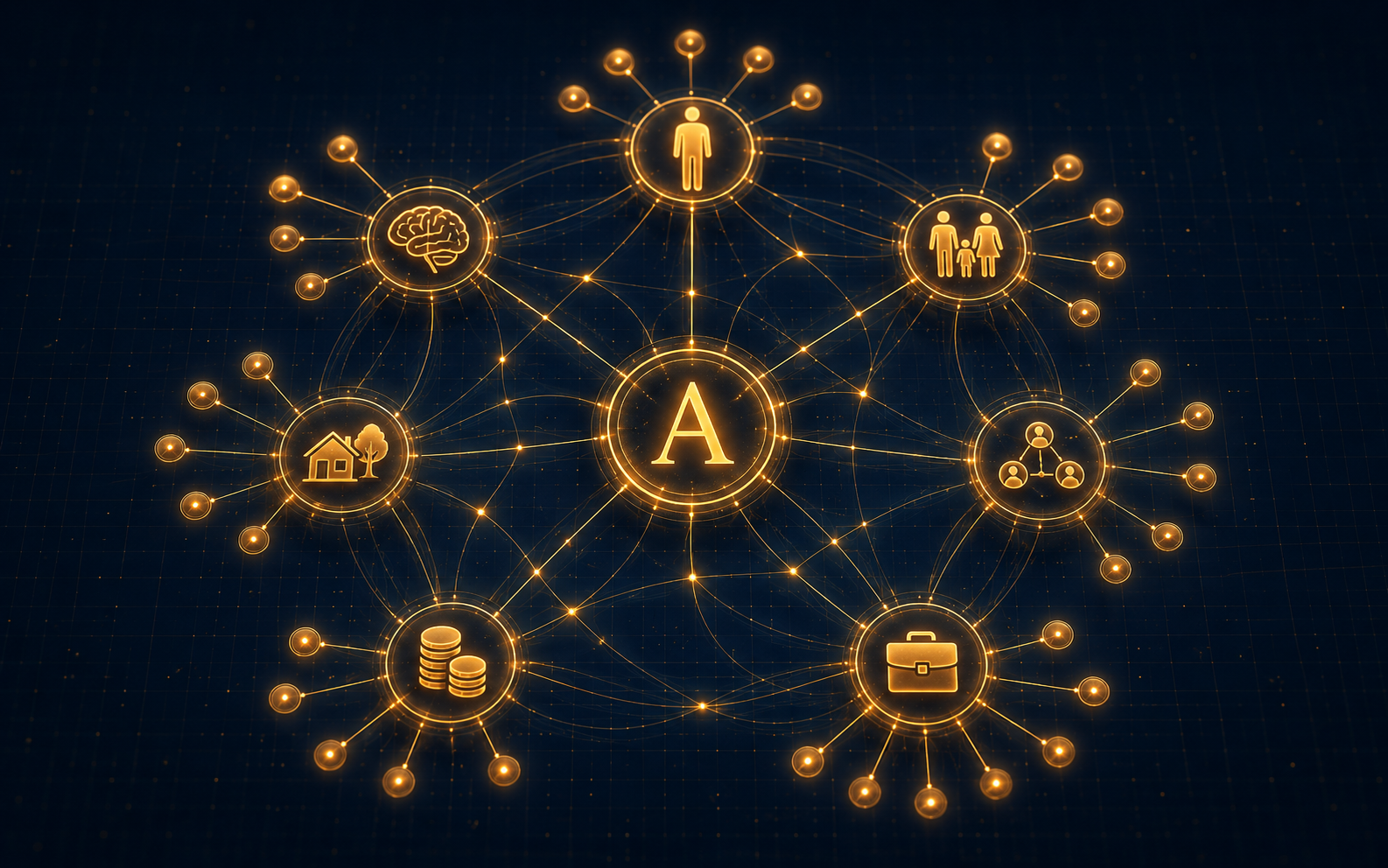
External tools can and often do become a natural extension of our minds. — Tiago Forte, Building a Second Brain
The biggest value comes from the fact that I build this system myself. It isn't a corporate template, it isn't a tool's built-in structure. It's my thinking, laid out in files.
Obsidian as the place where it all connects
Obsidian is my window into these folders — a program that lets me see all the Markdown files as a connected network. Links, search, a graph showing how ideas relate.
But it's important to understand one thing. Obsidian doesn't store the data. My machine does. If Obsidian disappears tomorrow, my files stay exactly as they are. I simply open another program that reads Markdown. There are dozens of them.
It's the place where I see my system. Not the place where my system lives.
How it works in business
On the business side, my system serves three main needs.
1. Client context
Every active client has a profile in the file system. It holds the goals of the collaboration, the history, the key decisions they've asked to keep written down, and the next steps.
One thing has to be clear here. Client information is not public and isn't shared with anyone. I choose which context to use with an AI assistant in any given moment, and if a client prefers, I use no cloud AI tool with them at all. It's a matter of agreement in each collaboration.
What gives value to a client isn't that I use AI. It's that I remember everything they said 3 months ago. That I can see connections between two different aspects of their business that they haven't spotted themselves. That I prepare for a call with full context, not with a blank page.
2. Sales call analysis
After every important call I synthesise the main ideas. What the other side is looking for. Their main blockers. The next logical step. Which of my assumptions changed after the call.
An AI assistant helps me see what I missed during the call. Tone, context, wording. It synthesises a 60-minute conversation into 5 key points. It's like a video replay after a match — you played it yourself, but you can step back and watch it from the outside and learn.
3. Marketing content
Blog posts, page copy, social posts, email campaigns. An AI assistant generates all of it, based on my full context. My voice, my experience, my language, my principles.
The biggest difference between how AI writes for an average person and how it writes for me is that in my case AI has access to a full profile of my voice. Asymmetric numbers. My particular way of avoiding clichés. The result is text that sounds like me, not like the default AI tone.
How it works in personal life
On the personal side the system serves my health, daily life and growth.
Health experiments
I experiment with my health systematically. A continuous glucose monitor with a constant data stream. Blood panels every 3–4 months. DNA analysis with specific genetic markers.
An AI assistant helps me see the connections. How sleep quality affects morning glucose. How specific foods change my blood values. How periods of stress show up in the biological data.
10 years ago this kind of analysis was only available to medical researchers with years of experience. Today it's in my hands, as long as the data is structured in the right formats.
Important to add: this is my personal experimentation, not medical advice. An AI assistant doesn't replace a doctor. It helps me prepare better for a conversation with a doctor and better understand what their advice means in my specific context.
Sport and nutrition
A Garmin watch automatically feeds my data into the file system. Heart-rate variability. Training load. Sleep phases. The AI assistant evaluates the weekly trend, not just a single day.
For diet, I've been following a 20:4 intermittent fasting protocol for more than 2 years. No sugar, no processed food, no alcohol. The AI assistant helps me understand how this protocol interacts with my goals and the shifts in my blood panels over time.
Daily planning
Every morning I score the 7 spheres on a 1–10 scale. It takes 5 minutes. An AI assistant aggregates these data points across the week and month and helps me see where the trend is positive and where extra attention is needed.
It isn't about perfect performance in every sphere. It's about catching the first signals that a sphere is sliding, before it becomes a problem.
Privacy and boundaries
I write this part carefully, because it's the most important question on this topic.
Principle one. My files live on my machine, not in someone else's cloud. While I do discuss some files with AI tools, that happens deliberately and by choice. I know which tool sees what data, and when.
Principle two. Some files are only for me. Medicine. Finance. Family. Here AI tools don't take part at all, or only in a very limited, anonymised form.
Principle three. If you work with me as a client, we agree on how your context is handled. If you don't want any information about your company to end up in cloud AI tools, we can do that. The choice stays with you.
Principle four. Not every problem needs an AI solution. Some decisions stay only in human hands. An AI assistant is a partner, not a replacement.
Open files don't mean "everything is public". It means "I know where my data is and I choose who sees it".
My vision: every person will need their own
Here I talk about why I believe this system will become the standard within the next 5 years.
A computer is the most remarkable tool that we've ever come up with, and it's the equivalent of a bicycle for our minds. — Steve Jobs, 1984
Steve Jobs compared a computer to a bicycle for the mind. AI is the next step in the same direction. But there's an important nuance. A bicycle only has value when you ride it yourself. If someone else rides it for you, you don't grow. The same goes for AI.
A person without their own database, who opens an AI tool, gets an average answer. The same answer anyone else asking a similar thing would get. AI knows no detail about that specific person.
A person with their own system, who opens an AI tool with their own context, gets a partner. An answer tuned to their situation, their history, their values, their goals.
This gap will grow over time. AI tools will get stronger, but their value will depend more and more on the quality of the context a person brings.
Markdown files are currently the world's most widespread open format for this purpose. That won't change in the next 10–15 years. Starting with Markdown files is the safest strategy if you're thinking about your second brain for the long term.
I build it for myself because I need it. But I also help clients put the same thing in place, because I see how this approach changes the way a person thinks about themselves, their business and their future.
That's how it is. I'm here for the conversation.
Next step
If this article resonated and you'd like to start building your own second brain, two directions.
Option 1. Start on your own. Download Obsidian, create 3 folders and 5 files, start writing down your thoughts. After 30 days, see how it feels. Many people can do this independently, and that's great.
Option 2. Start with a conversation. If you want a more systematic approach, integrated with your business and life goals, get in touch.
Want to start building your own second brain?
The personal system described here grew into the company-level work I now do at Arete AIOS. The steps below are enough to build your own version; Arete AIOS shows what the guided version for companies looks like.
Egils Boitmanis: 20+ years of experience in business, digital marketing, training and practical AI use. Founder of Infinitum 8, Google Certified Trainer, and runs practical AI and Lovable workshops for teams. He has been building his own second-brain system for 3 years. His active work with companies now continues at Arete AIOS.
Frequently asked questions
A company-owned AI business brain
From single AI tools to one connected brain your company owns. That is what I build at Arete AIOS.
Related articles
What AI Connect helped me name more precisely about AI business brains
Speaking publicly about AI business brains forced me to put into words something I'd felt but never precisely named before.
An AI partner and assistant for a company that isn't mine
I built an AI partner and assistant for a small company I don't own. The real question was never technical: does the method transfer to another person and another business, or does it only work because I built it for myself? Here is the answer, the entry point that surprised me, and the five skills it stands on.
AI Circle at your company: why culture change matters more than tools
57% of employees globally hide how they use AI at work. That's not a tech problem — it's a culture problem. Here's how I've helped Latvian companies change that culture, and how you can start your own AI Circle next week.