
AI Circle at your company: why culture change matters more than tools
57% of employees globally hide how they use AI at work. That's not a tech problem — it's a culture problem. Here's how I've helped Latvian companies change that culture, and how you can start your own AI Circle next week.

Listen to this article
Narrated with an AI voice built from the author's voice.
The reality nobody talks about
First an honest number. Seventeen out of every 30 employees hide how they use AI in their daily work.
That comes from the 2025 KPMG and University of Melbourne global study of 48,000 people across 47 countries. The exact figure is 57%. In the US, Ivanti's research shows 32%, Laserfiche's shows 49%. Numbers vary by country and industry, but the picture is the same.
People use AI but don't talk about it at work.
Three main reasons. Fear of losing the job (30% in Ivanti). The wish to keep a "secret competitive edge" over colleagues (36%). Imposter syndrome — doubting whether you still actually earn your salary (27%).
When employees feel like AI is their 'dirty little secret,' that's not a tech problem, it's a leadership one. — Karl Chan, Laserfiche CEO
This is the root issue most companies don't face directly, because neither leadership nor staff talk about it openly. But the consequences are real.
Why this is a problem for the company
Three main consequences I've noticed in my engagements.
First. Data security risk. 48% of employees who use AI in secret admit they enter sensitive company data into public AI tools. Without leadership awareness, without policies, without control.
Second. Duplicated work. When each employee experiments alone, the same problem is solved 5 times in 5 different places. Nobody shares what works and what doesn't. The company's overall progress is 5x slower than it could be.
Third. A culture gap. This is the most important and the hardest to notice. When some people grow rapidly with AI but the company as a whole doesn't keep up, internal conflict appears. The person who's developed becomes uncomfortable in their environment. Those who haven't feel left behind.
In my experience the third point is what costs the most long-term — the way the best people quietly leave because they no longer fit the culture they work in.
What an AI-first culture means
AI-first is a term Google CEO Sundar Pichai coined in 2017 when he said we're moving from mobile-first to AI-first. In 2025 it's no longer a future vision — it's what serious companies already do.
Shopify CEO Tobi Lütke's internal memo in April 2025 announced that no new role would be approved until the team proved AI couldn't do the job. That's the strict end.
I don't propose that strict version. But the principle is the same. AI-first isn't that every task must be done with AI. AI-first is that the first question for any problem is "could AI help here?".
AI doesn't fail because the models are weak — it fails because the behaviors around them never change. — Gradera, 2025
The technology is ready. The models are strong. What doesn't change are human habits and company culture. That's why most AI rollouts end up as a collection of tools nobody really uses.
AI Circle: a simple idea that works
Over the past 2 years I've helped several Latvian companies introduce a format I call AI Circle.
The core principle is simple. Once a month or twice a month, the team meets for 60-90 minutes. The meeting splits into 3 parts.
Part one: news
10-15 minutes on what's new in AI in the last 2-4 weeks. New models. New tools. New use cases. Not a technical presentation — a simple overview anyone could read on LinkedIn or hear on a podcast.
The goal isn't expertise. The goal is shared language. So everyone talks about the same context.
Part two: sharing
This is the heart of the meeting. Each participant takes 5-10 minutes to share one thing they tried or discovered with AI in recent weeks.
It might be a success story ("I used ChatGPT to do 3 hours of work in 30 minutes"). It might be a failure ("I tried Claude to analyse our customer data, but the result was bad, here's why"). It might be a new tool. It might be a simple prompt formula for a specific work task.
Important. Everyone shares. Not just the enthusiasts. Not just leaders. Everyone. Even those who say "I don't do anything interesting". Often they're doing the most interesting things, they just don't see it themselves.
Part three: next step
In the last 15-20 minutes we define what each person will try before the next meeting. One concrete experiment. One, not five.
It might be "next month I'll try Lovable to build our customer contact form". Or "I'll see whether n8n can automate logging our sales calls". Or "I'll test whether the new model handles Latvian better".
At the next meeting we report back on what came out.
How it evolves over time
At the start, most people talk about simple things. Using ChatGPT, Claude or Gemini for emails. Writing a better LinkedIn post. Simplifying the weekly report.
That's fine. Starting from basics people gain confidence. Imposter syndrome drops when you see your colleague is also just starting.
After 2-3 months the depth of sharing changes. People start trying more complex things. Lovable to prototype an internal tool. Automations with Make or n8n. Specific AI agents for specific tasks.
After 6-9 months something even more interesting happens. People start helping each other. Whoever's gotten stronger in Lovable shows a colleague how to start. Whoever discovers a new tool opens it up for others. An internal knowledge community forms — valuable in itself.
An AI-first culture has very little to do with tools and everything to do with mindset. — Silent Partners, 2025
This mental shift is what you can't buy with AI licences. It has to be grown inside.
Gamification and culture
In several companies I've also introduced a light gamification layer. It's not mandatory, but works well where the team already has a competitive culture.
A few formats that have worked:
AI discovery of the month. The team votes for one person who showed the most useful AI use case in the month. A small symbolic recognition — maybe a gift card or lunch with the leader.
Internal hackathon. Once a quarter the team dedicates a full day to building something new with AI. A simple prototype that solves a real company problem. Often what starts there becomes a real company tool in 3-6 months.
Buddy system. The more experienced pair up with those still starting. 30 minutes a week together. Not formal training — just "I'll show you what I do".
How I enter a company
When a company asks for help to introduce AI Circle, it typically looks like this.
First month. Discovery. I meet 5-7 people from different levels. The leader. Staff from different teams. Someone who's already experimenting and someone who hasn't started at all. The goal is to understand the existing culture, who's afraid, who's an enthusiast, where the conflicts are.
Second month. First AI Circle meeting. I run it myself. I show the format, ask questions, help people share even when it's uncomfortable. The first time is usually the hardest.
Months three to six. I'm present at each meeting, but my role narrows. At the start I speak 60% of the time. After 3 months — 20%. After 6 months ideally 0%, because the team has taken the format and runs it without me.
After that. I no longer attend, but stay available for questions or a specific workshop on a specific topic. Some companies continue with me 1-2 times a year as a consultant who opens a new department or gives a new-model release overview.
What I tell my clients clearly. The goal of my involvement is that after 6 months I'm no longer needed. If I remain needed longer, I did something wrong.
But you can start on your own
There's nothing magical here. What I do can be done by an internal person too, if they have the will and the authority.
Here's my recommended minimal start.
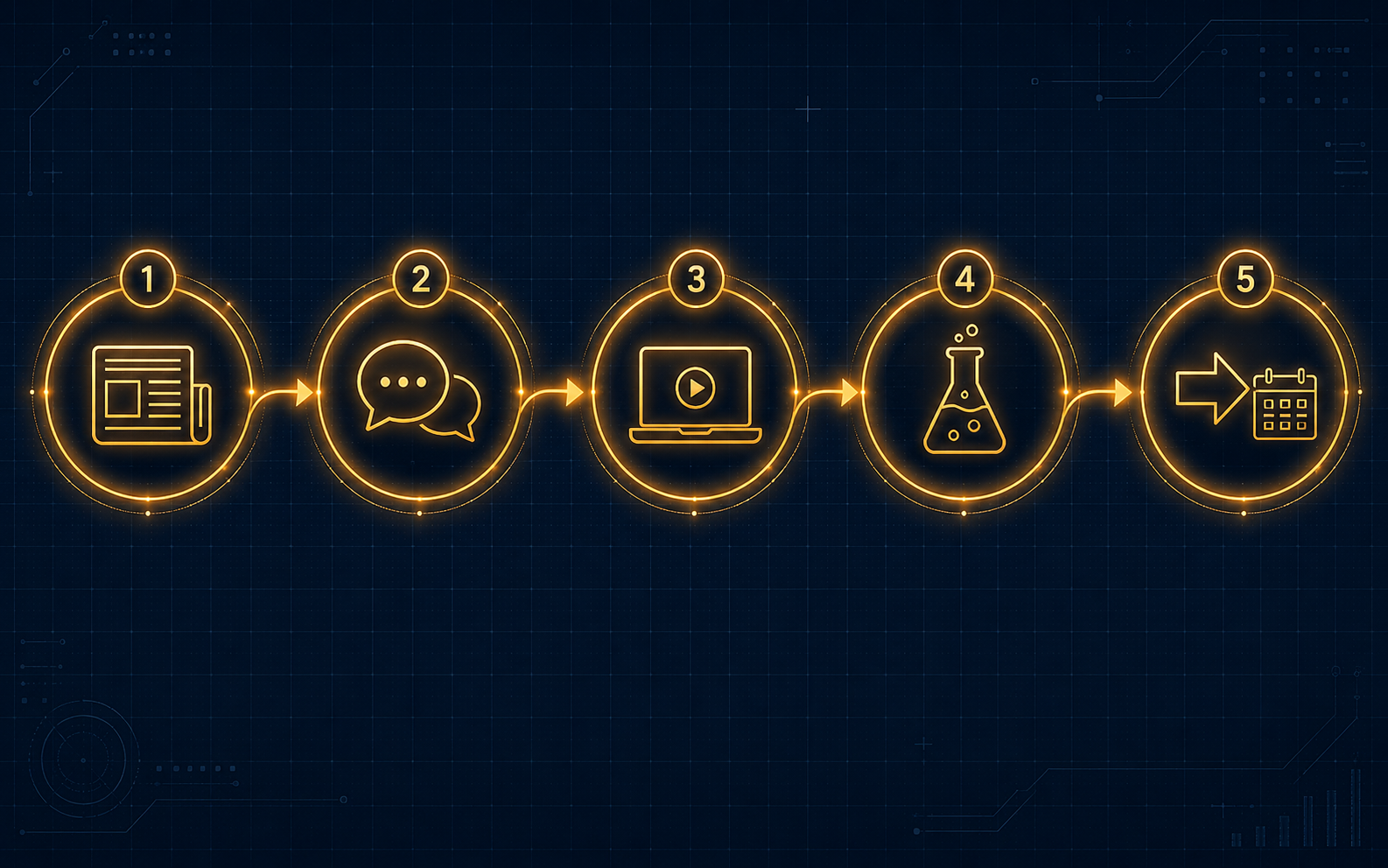
Step 1. A date in the calendar. Not "sometime". A specific date. E.g. the first Thursday of each month, 14:00, 90 minutes. Put it in everyone's calendar for the next 6 months at once.
Step 2. First meeting. Simple format. Each person answers 3 questions:
- What have you tried with AI in the last 4 weeks?
- What worked?
- What didn't?
Step 3. Experiment task. Before the next meeting, each person spends 30 minutes trying one new thing with AI. Not a big project. 30 minutes.
Step 4. Second meeting. Report back. What happened? What did you learn?
Step 5. Repeat. Once a month, for 6 months. Then look at where you are.
The first signal it's working
You'll know AI Circle is starting to work when two things happen.
First signal. Someone openly says during a meeting: "I tried what you showed last time, and it worked." That means people are no longer hiding knowledge. They share it.
Second signal. The first time someone who started out sceptical, even resistant, is the first to answer the question "Has anyone tried anything?". That means culture has shifted. Being inside is now the default — not being outside.
That's it. I'm here for the conversation.
Want to start your own AI Circle?
AI Circle sessions and practical AI workshops for teams continue as part of my speaking and training work. The training page shows the formats and selected talks; the step-by-step guide below is enough to start on your own.
Or write to info@fullmarketing.me with a short brief — team size, current AI usage level, and what outcome would be valuable after 6 months.
Egils Boitmanis: 20+ years of experience in business, digital marketing, training and practical AI use. Founder of Infinitum 8, Google Certified Trainer, and runs practical AI and Lovable workshops for teams. He has helped several Latvian companies introduce the AI Circle format as part of a broader culture shift. His active work with companies now continues at Arete AIOS.
Frequently asked questions
A company-owned AI business brain
From single AI tools to one connected brain your company owns. That is what I build at Arete AIOS.
Related articles
What AI Connect helped me name more precisely about AI business brains
Speaking publicly about AI business brains forced me to put into words something I'd felt but never precisely named before.
An AI partner and assistant for a company that isn't mine
I built an AI partner and assistant for a small company I don't own. The real question was never technical: does the method transfer to another person and another business, or does it only work because I built it for myself? Here is the answer, the entry point that surprised me, and the five skills it stands on.
My second brain: how I use AI in business and personal life
I use several AI tools in parallel every day, but my entire system rests on one principle — files that I control. The story of how I wire AI into business and personal life, and why every person will need a system like this within the next 5 years.