

Inside DeepDive: 32 questions that changed how I work with clients
DeepDive is a 32-question assessment in 5 sections, built on the AIOS framework. It serves three purposes: a concrete starting point for a 6-month engagement, a self-discovery process for the client, and the foundation for building their AI partner profile. After dozens of completed assessments, I've learned that filling it out often delivers 50% of the total value on its own.

Listen to this article
Narrated with an AI voice built from the author's voice.
Why I needed a starting point
A few years ago I realised I was missing something important when starting work with a new client.
We'd meet. We'd talk. We'd start working. But after 3 months, when the client asked "how am I doing?", I couldn't answer honestly. Compared to what? To what they thought about themselves 3 months ago? I didn't know that precisely. Only a vague feeling.
That's not a professional approach.
If I had an hour to solve a problem, I would spend the first 55 minutes determining the proper questions to ask. — Albert Einstein
I came back to Einstein's idea that questions come first. Right questions before answers. A clear starting point before solutions. That's how DeepDive was born.
What DeepDive actually is
DeepDive is a 32-question assessment the client completes before our full engagement begins. It's structured in 5 sections, built on the AIOS framework with 4 phases. OWN. SIMPLIFY. SYSTEMATIZE. SCALE.
Available in both Latvian and English. Completion time is between 60 and 120 minutes, depending on how deep someone wants to go.
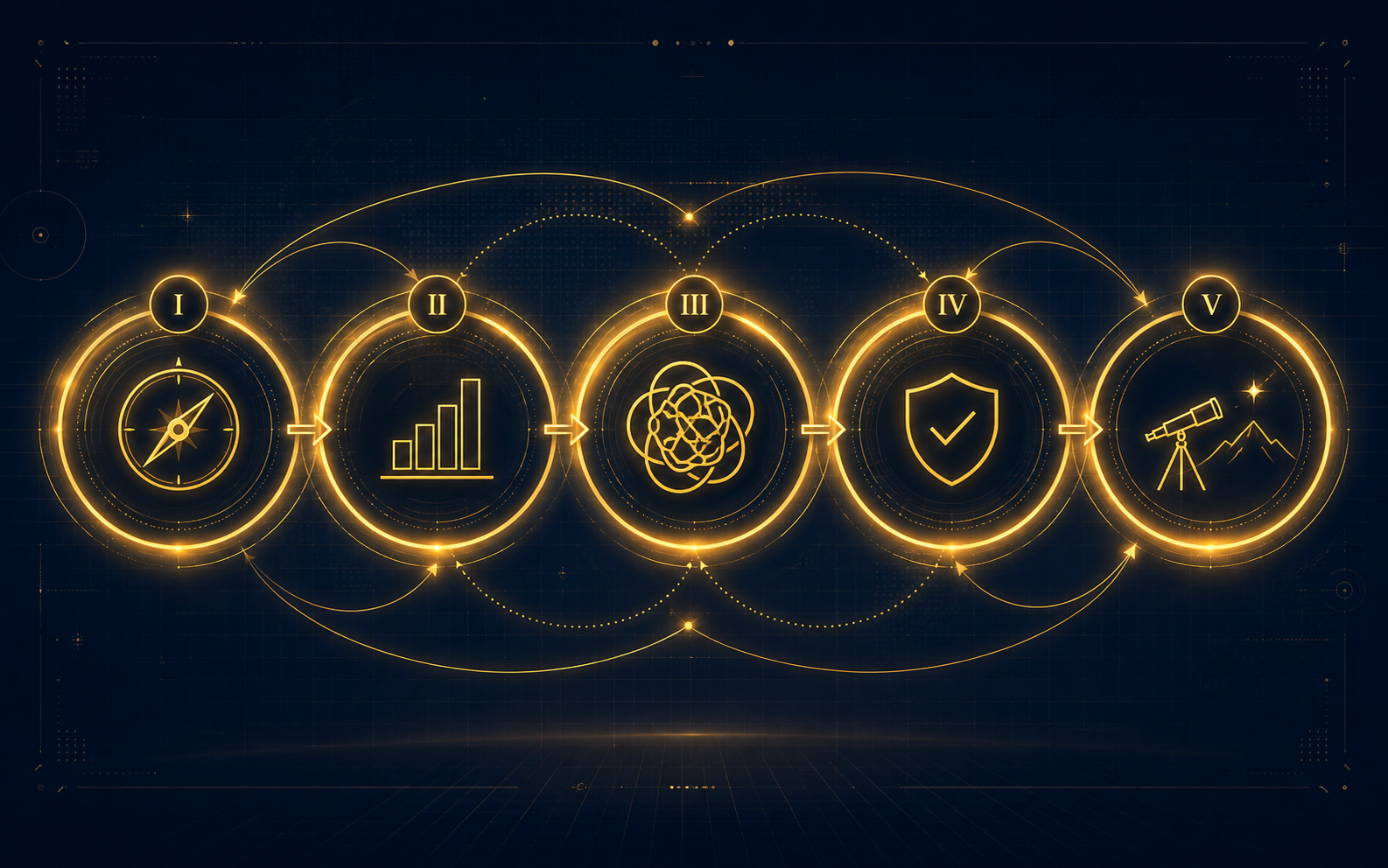
The 5 sections
1. YOU — Inner compass and personal drivers. 6 questions about life events, values, natural abilities and personal mission. Why? Business is an extension of the person. You can't put a business in order without understanding the person behind it.
2. BUSINESS SNAPSHOT — Offers, revenue, clients and processes. 7 questions about current structure. Why? Before changing anything, we need to know what currently works.
3. BOTTLENECKS — Mindset and operational constraints. 4 questions about internal blocks, biggest failures, manual processes and energy leaks. Why? Most business problems aren't strategic — they're personal.
4. ASSETS AND EVIDENCE — Leverage you already own. 6 questions about client results, materials, systems, biggest achievements and acquired skills. Why? People often focus more on what's missing than on what's already there.
5. VISION AND AI POWER — The future you want to build. 9 questions about the 12-month goal, ideal day in 3 years, habit change, social circle, work environment and readiness to invest. Why? Without a clear future, any improvements are accidents.
What I see in the very first answer
After dozens of completed assessments, I've noticed concrete patterns. The answers signal much more than what's literally written.
Discipline. How quickly does the client complete it after receiving it? In one evening or three weeks? Someone who finishes all 32 questions within 24 hours is a different kind of partner than someone who keeps postponing. That same character will show up over the next 6 months.
Openness. Does the person answer question 14 (biggest internal blocks and limiting beliefs) in two words or in three paragraphs? How far can they go in honest self-analysis? That same level stays in our conversations.
Depth of thinking. There's a difference between "I want more clients" and "I want clients who pay 3× more and spend half as much of my time chasing me with 'when will it be ready'." The first is a wish. The second is analysis.
Questions inside the answers. Often answers to old questions reveal new ones the client asks me. "Do you think I should change my whole positioning strategy, or just price?" Those embedded questions are often more valuable than the answers I was looking for.
Partnership potential. Someone who, in question 32 (ideal client), clearly describes their audience is usually already ready to work systematically. Someone who writes "anyone who needs my help" is usually still looking for their position in the market.
All of this gives me context before the first call. So I start the first call honestly: "I spent 2 hours with your answers. Here are 5 things I noticed before you even started talking." That changes the dynamic of the whole conversation.
First value: the process itself changes the person
You do not rise to the level of your answers. You fall to the level of your questions. The more powerful your questions, the more transformative the conversation. — Rich Litvin, The Prosperous Coach
The biggest value of DeepDive often isn't my insights from the client's answers. It's what happens inside the client while they're answering.
Clients often write to me after completing it: "I didn't know I felt that way about it." Or "For the first time I wrote down honestly what I actually think about our team." Or "I sat for 15 minutes on question 27 about daily habits and realised I don't even have clarity about it."
That's roughly 50% of DeepDive's total value. Not because I'm magical. Because the right question at the right time forces a person to recognise what they already knew but hadn't put into words.
I tell my clients clearly: if you fill out DeepDive honestly, you'll already have changed before we even meet. I'll just help you see what you wrote yourself.
Second value: building the AI partner profile
Over the past year this aspect has become even more important. I help clients build their own AI partner or assistant that knows them.
The process looks like this.
Step 1. Load the client's CV or LinkedIn profile as context for the AI tool.
Step 2. Load the completed DeepDive assessment.
Step 3. Add additional context: specific client profiles, existing marketing materials, voice samples from previously written content.
Step 4. Build a unified client profile that lives in a Markdown file and serves as the context foundation for any future AI conversation.
Result. The AI assistant no longer knows just "some business owner." It knows this specific person. Their history, values, goals, language, clients, problems.
The quality of your life is determined by the quality of the questions you ask. — Tony Robbins
This is exactly the power difference I wrote about in my earlier post on second brains. An AI tool without context gives an average answer. An AI tool with your full DeepDive context gives an answer tailored specifically to you.
Content that sounds like you. Decisions that fit your situation. Planning that matches your pace. All of that becomes possible when the AI knows who you are.
Measuring after 6 months
The most important value, the original reason I built DeepDive, remains the same. A concrete baseline measurement.
After 6 months with a client, we open their original DeepDive file. We read the answers. We compare with where they are now.
It often looks like this.
"6 months ago you wrote that your biggest block was procrastination on marketing activities. Is that still true?"
"6 months ago your goal was €5,000/month. Now you're at €7,500. Is that the best you want, or are we going further?"
"6 months ago you described your ideal day in 3 years as a specific picture. How far are you from it now?"
That gives both the client and me a concrete measurement. Not just a feeling of "he's grown" but a visible comparison between the person's own words before and after.
You can build your own DeepDive
Here's something few consultants will say openly. You can start this process on your own — without me.
I tell my clients honestly: if you want to try it independently, you can do it yourself with AI. Here's a concrete process.
Step 1. Open any AI tool (Claude, ChatGPT, Gemini, any). Write roughly this prompt:
"I'm a founder/expert. I want to build a structured self-assessment of my business and life. Please create 30 deep questions across five sections: 1) inner compass and values, 2) business snapshot and revenue, 3) constraints and blocks, 4) existing assets and achievements, 5) vision and ambitions. Questions should force deep self-reflection, not surface-level answers."
Step 2. Answer honestly. 60-120 minutes. Don't rush. If a question is hard, stay with it longer. The hardest questions usually give the most valuable answers.
Step 3. After all 30 questions, ask the AI: "Based on my answers, what additional 5-10 questions would you ask me so I have full clarity?" Answer those too.
Step 4. Repeat step 3 another 2-3 times. Each round the AI will ask new questions based on your previous answers. Stop when questions start repeating and no longer add clarity.
Step 5. Save everything in one Markdown file on your computer. That's your DeepDive baseline. Reopen it after 3 and 6 months.
Step 6. After 30 days ask the AI: "Based on my DeepDive, what would be the 3 concrete next steps for the coming month?"
That's 80% of what I do with my clients. On your own you can get 80% of the value at 0% of the cost.
Why doing it with me is still better
That doesn't mean my involvement is only worth 20%. It means that added 20% isn't for everyone.
Here's an honest description of why people choose to work with me:
An outside view. I've seen dozens of completed assessments. I know what patterns look like across many people, not just one. I can say: "Your answers to questions 14 and 27 together show that your biggest problem isn't what you think. It's something else."
Links between answers. Most people answer each question in isolation. I see how the answer to question 2 (what comes naturally to you) connects to question 21 (where you're sitting on unused value). That link is usually the one the person can't see themselves.
A structured process. I don't work with clients "as it goes." After DeepDive we have a concrete 6-month cycle with monthly check-ins, mid-point and end-point reviews, and a change of direction if something isn't working.
Follow-through. The fact that someone works with me and pays for it already changes their attitude toward their DeepDive. It's not a one-off questionnaire to fill in and forget. It becomes a living document we work on together.
That's how it is. I'm here for the conversation.
Want to try your own DeepDive?
DeepDive now lives inside Arete AIOS, where the guided version of this process continues. Or run it yourself tonight with the steps below. The choice is yours.
Or email info@fullmarketing.me with a short note — your business context, the main challenge right now and what result would be valuable in 6 months.
Egils Boitmanis: 20+ years of experience in business, digital marketing, training and practical AI use. Founder of Infinitum 8, Google Certified Trainer, and runs hands-on AI and Lovable workshops for teams. He designed the DeepDive assessment on the AIOS framework and used it in engagements with dozens of clients. His active work with companies now continues at Arete AIOS.
Frequently asked questions
Where this thinking continues
ARETE is the idea. The working method for companies now lives at Arete AIOS.
Related articles
The next chapter of FullMarketing: my active work now lives at Arete AIOS
FullMarketing stays my professional archive: articles, testimonials, speaking. My active work with companies now happens at Arete AIOS.
ARETE: what it means, and how I use it in my work with founders
ARETE is an ancient Greek word that can be translated as a person's highest potential, or excellence in practice. This piece separates three things: the idea itself, my personal Arete OS, and the Arete AIOS method for companies.